
Small businesses bear the brunt of Kenya's power cuts
Our survey with BCG of 4,511 small-business owners: 79% say outages cut or stop their trading, and about half have put off buying stock or equipment.
First published as an op-ed in Business Daily on 11 October 2026.
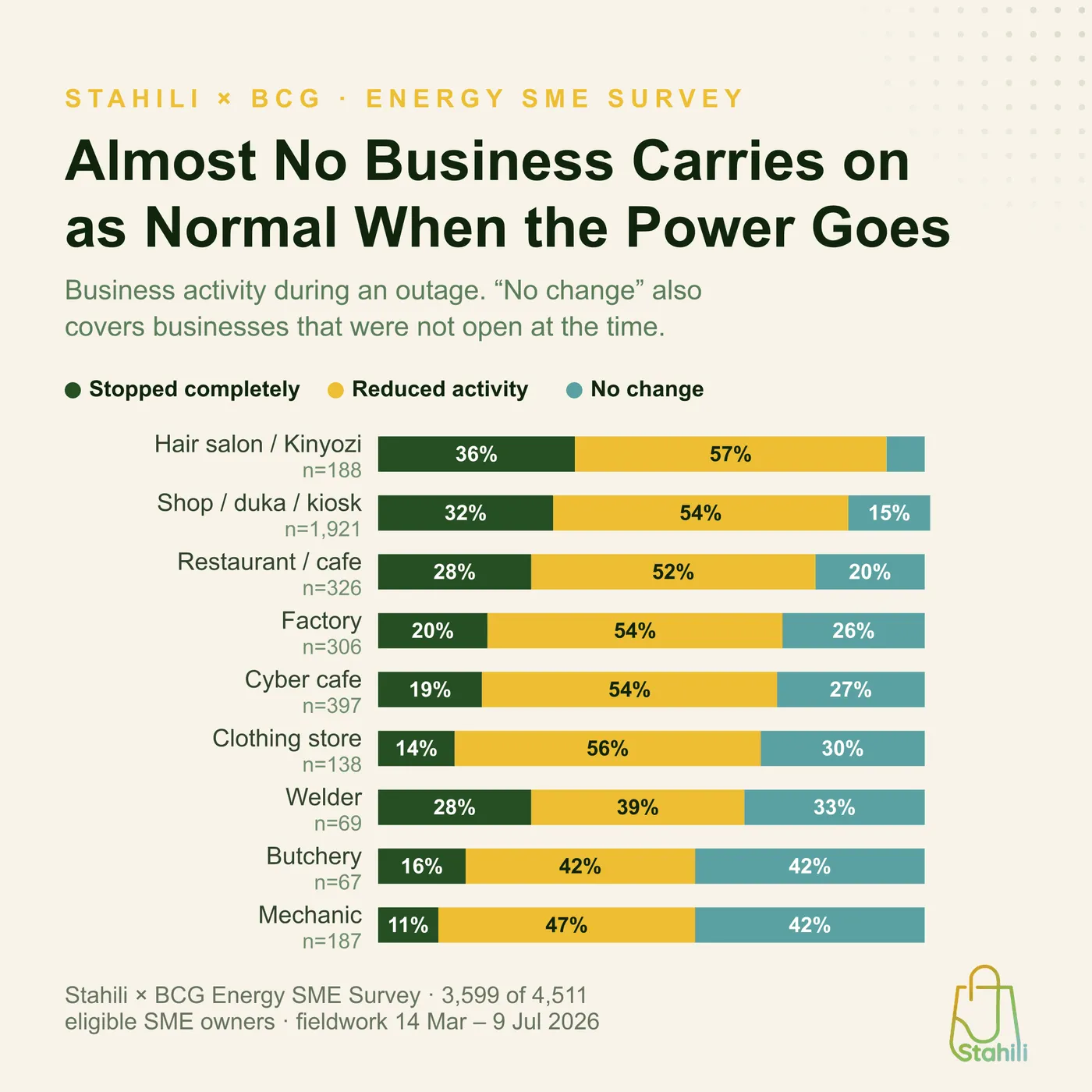
When the power goes off in Kenya, most small businesses do not simply wait it out. Together with Boston Consulting Group (BCG), we asked 4,511 small-business owners across the country what an outage does to their trade, what it stops them buying, and what they would give for a supply they could rely on. BCG and Stahili set out the findings in an op-ed in Business Daily on 11 October, and BCG shared them on LinkedIn on 15 October. This is the short version, with the charts.
Almost nobody carries on as normal
Four in five owners (79%) say a power cut reduces or stops their trading, and a quarter (25%) stop altogether until the power comes back.
How hard an outage bites depends on what the business sells. Hair salons and kinyozis are hit hardest: 93% slow down or shut, which is no surprise in a trade that runs on clippers, dryers and lights. Shops and dukas follow at 86%. Restaurants and cafes are close behind at 80%.
Mechanics and butcheries look the most resilient, with 42% of each reporting no change. That figure flatters them a little: in the survey, “no change” also counts owners whose business was not open when the outage hit.
Unreliable power changes what businesses buy
The cost does not end when the lights come back. About half of owners (52%) have put off buying stock or equipment because the power is unreliable. New stock and new equipment both earn their keep only while the business can trade, so every outage makes the next purchase a harder call.
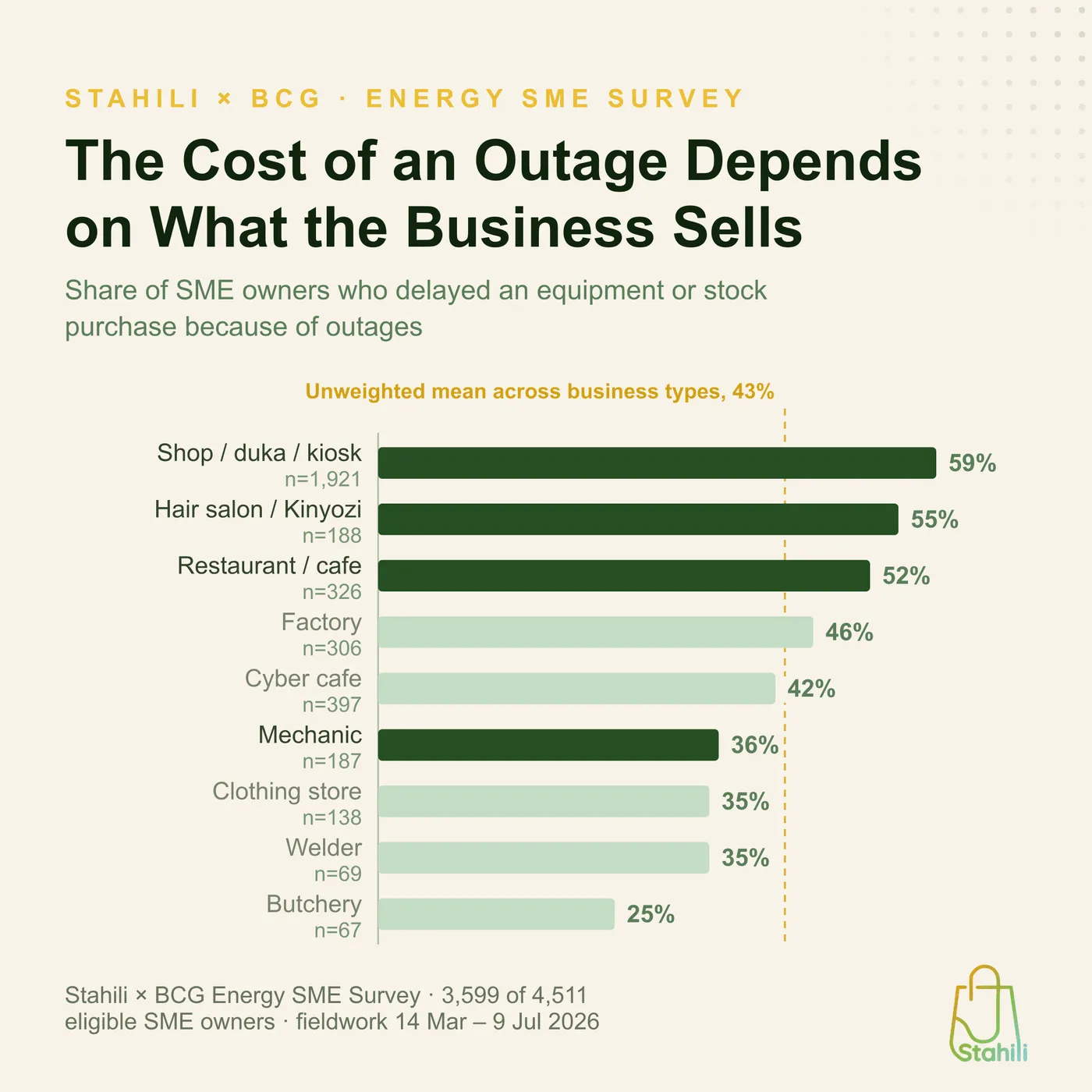
Share of owners who delayed an equipment or stock purchase because of outages, by type of business. The dashed line at 43% is the simple average of the nine business types, not the share of owners; across all owners the figure is 52%.
Shops (59%), salons (55%) and restaurants (52%) delay purchases most. These are the same businesses that lose the most trading time, and shops make up the largest group of owners in the survey, which is why the overall figure sits above the average of the nine bars.
Owners are already paying to cope
Most businesses have stopped waiting for the grid. 89% already use some form of backup power, and solar is both the most common choice and the one owners most often plan to buy next.
That spending is a signal. 74% of owners say they would pay more for a reliable supply. For many small businesses the question is no longer whether power is worth paying for, but who they can trust to deliver it.
Why it matters beyond energy
An outage is a cost that every shop, salon and restaurant carries, and it shapes what they stock and when they invest. For brands that sell through Kenya’s dukas and kiosks, it decides whether a fridge is switched on, whether a new line gets ordered, and whether a customer is served at all.
We run surveys like this every week with Kenyan consumers and business owners. If there is a question you would like answered about your own market, an Ad-Hoc Survey is the quickest way to get it in front of the people who know.
About the research
The Stahili × BCG Energy SME Survey interviewed 4,511 small and medium-sized business owners across Kenya, with fieldwork from 14 March to 9 July 2026. The charts show nine of the twelve business types in the survey, 3,599 owners in all, and each bar carries its own base. Our thanks to the BCG team we worked with on the study.
Have a question about your market?
We put questions like these to Kenyan consumers and business owners every week.